Legislative Report 2/7/2022 - We can clean up our heating sources


It is very apparent by now that climate change is happening both locally and globally with rising average temperatures and devastating effects, including extraordinary wildfires, flooding, and other extreme weather events. In September 2020, the Vermont Legislature enacted the Global Warming Solutions Act (Act 153) that set greenhouse gas (GHG) reduction targets and created a Climate Council to develop a Climate Action Plan (CAP) to achieve those targets. The Climate Council published its report in December 2021, and in January the Legislature began working to implement it.


Transportation accounts for about 40% of GHG emissions in Vermont and heating accounts for about 34%.  Targeting these two energy-intensive sectors will give us the best chance of meeting the target of a 40% reduction from 1990 levels of GHG emissions by 2030. The House Energy and Technology Committee has started crafting legislation from some of the specific recommendations of the Climate Action Plan regarding heating, including a Municipal Energy Resilience Plan (bill H.518) and a Clean Heat Standard.
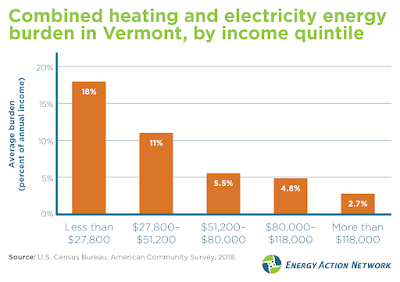
 

The Climate Council was careful to insist that whatever
measures were taken to reduce GHG emissions, that they be done in an equitable manner to prevent impacting those with the highest energy burden.  Energy burden is defined as the total household energy expenses for heating and electricity divided by household income. The highest energy burden is experienced by the 20% of Vermonters with the lowest income as shown in the accompanying chart. Energy burden profiles can also be associated geographically with the highest energy burdens occurring in rural communities because of increased transportation fuel costs.


Vermont’s cities, towns and villages own and maintain approximately 7,000 old buildings that are expensive to heat and have a large carbon footprint. To meet our climate goals and ease the energy burden on municipal budgets, H.518 will support communities with technical assistance, design support, and funding to make municipal assets more energy efficient and to displace fossil fuels with cleaner options. It will expand the State Energy Management Program to help municipalities finance improvements and assist municipal leaders, who may lack the technical expertise to assess the best investments to increase efficiency and resilience, with help from Efficiency VT and regional planning commissions.


With one-third of Vermont’s climate pollution coming primarily from fossil fuels used to heat our buildings and water, dependence on fossil fuels is expensive with unpredictable price swings for consumers. If you heat your home with oil or propane, you’re paying as much as 40% above last year’s prices. This creates an especially large energy burden for lower-income Vermonters. Unlike our highly regulated electric sector, which is subject to the renewable energy standard (RES), fossil fuel corporations are under no obligation to reduce the carbon pollution of their product. A Clean Heat Standard (CHS) would require fossil fuel corporations to provide cleaner heating fuel options and/or pay for pollution-reduction measures that benefit Vermonters. These include employing cleaner heating options, like heat pumps, heat pump water heaters, and advanced wood heat to displace fossil fuels, or supporting weatherization and efficiency measures. A CHS places the obligation of lowering emissions on fuel sellers while presenting Vermonters with choices on how and when to move to cleaner heat. To ensure equity in the application of the CHS we are considering various design options such as requiring a high fraction of credits to come from serving low- and moderate- income homes, providing extra credits for providing clean heat in rental housing, and making incentive payments income-sensitive. Without implementing a CHS, Vermont will not meet its emissions reduction requirements under the Global Warming Solutions Act.


As always, I welcome your emails (myantachka.dfa@gmail.com) or phone calls (802-233-5238).  

Apologies!

 I apologize for not updating this website since the Legislature adjourned in May of 2021.  A lot has happened since then, including a number of articles I wrote for our local newspapers. I have included them below with the following dates:

7/2/2021  General Assembly overrides vetoes

11/29/2021  Rising COVID cases prompt special legislative session

1/8/2022  New legislative session looks ahead

1/22/2022  Artificial Intelligence: Opportunity and Risk

Fortunately, Blogger allows me to backdate the posts to when they should have been posted.

Legislative Report 1/22/2022 - Artificial Intelligence: Opportunity and Risk


Jeopardy host: In the category Technology, systems (usually software) capable of perceiving an environment through data acquisition and then processing and interpreting the derived information to take action or imitate intelligent behavior given a specified goal.

Watson: What is Artificial Intelligence?


Many years ago, I went through a period of reading Isaac Asimov’s novels about robots, the kind that exhibited human functions, what we would call androids today. His first robot novel I, Robot was a collection of short stories about robots with human-like personalities that performed various jobs, like childcare for example.  Robots and androids have been a staple of literature from ancient times (search “Robots in Literature”), and most of us are familiar with those of the Star Wars anthology. We aren’t quite at the C3-PO stage yet, but the artificial intelligence that the robots of science fiction exhibited has become a reality with the development of high-powered computers today.


We are surrounded by artificial intelligence, also known as “AI”, whether we recognize it or not.  The first AI algorithm was created and used successfully to master the game of checkers in 1956 by Dartmouth scholars. Fast forward to 2011 and IBM’s supercomputer, dubbed “Watson”, competed against two Jeopardy champions, and won. The dialog at the top of this column did not actually take place, but it serves to define what AI is. Today we use AI to guide us to destinations, predict the weather, translate languages, for facial recognition, and many other applications. AI is used for scientific research, medical diagnoses, autonomous vehicles, and more; and the government, including the Defense Department, funds advanced research in AI.  AI is the source of many benefits, but it can also pose a risk if it is used improperly.  For example, ubiquitous use of facial recognition threatens our expectations of personal privacy. And systems that determine eligibility for services can have built in biases.


Already, AI is creating a wave of economic growth in Vermont with high-paying jobs in this field. The legislature recognizes both the economic potential and the potential for abuse associated with AI development and use.  Act 137 of 2018 created an Artificial Intelligence Task Force to investigate the field of artificial intelligence in the State and make recommendations on the responsible growth of Vermont’s emerging technology markets, the use of artificial intelligence in State government, and State regulation of the artificial intelligence field. The task force’s report was issued in January 2020 and can be found at https://legislature.vermont.gov/assets/Legislative-Reports/Artificial-Intelligence-Task-Force-Final-Report-1.15.2020.pdf. 


The report states that "there is in fact a role for local and state action, especially where national and international action is not occurring. Large scale technological change makes states rivals for the economic rewards, [whereas] inaction leaves states behind. States can become leaders in crafting appropriate responses to technological change that eventually produces policy and action around the country."


Members of my committee, Energy and Technology, worked on a bill, H.410, over the summer that implements some of the recommendations of the Task Force, and we voted it out of committee last week. It creates an AI Commission under the auspices of the Agency of Digital Services, and requires a survey of all software applications purchased, developed, or used by State agencies or departments. We want to know if any applications use AI, how it is used, and the potential impacts on Vermont citizens. The bill is awaiting action by the Appropriations Committee and will eventually be voted on by the full House.


As always, I welcome your emails (myantachka.dfa@gmail.com) or phone calls (802-233-5238). 

Legislative Report 1/8/2022 - New legislative session looks ahead


On Tuesday, January 4, the legislature returned to Montpelier in person for the second half of the biennium.  In a floor session that lasted about 45 minutes, resolutions were passed to allow the House and Senate to meet and conduct business remotely until January 18 because of the rising number of COVID cases due to the much more contagious omicron variant. The intent of the legislature is to re-evaluate the situation mid-month to determine whether it will be ok to return in-person. As we begin the third year of the COVID-19 pandemic, we have to remain vigilant to prevent its spread as much as possible.

But legislative work must be done. On Wednesday Governor Scott delivered his State of the State address to the Legislature.  He laid out his priorities to increase housing, develop Vermont’s workforce, and use the federal assistance that the state received from the American Rescue Plan Act (ARPA) and the Infrastructure Act.  His priorities match well with the priorities of the Democratic led Legislature, which is to help families, businesses and our economy thrive. Building on the work we accomplished in 2021, we’re ready to hammer out detailed proposals — and make significant investments — that make a real difference for Vermonters.

This will include taking smart, strategic action on climate. The Vermont Climate Council, created by the Global Warming Solutions Act passed last year, has delivered its report with recommendations on steps to reduce greenhouse gas emissions, sequester carbon through agricultural and forestry land management practices, and adapt our infrastructure to the effects of climate change, and to accomplish these tasks with an eye toward racial and social equity.  

We plan to resolve our pension crisis in a way that’s fair to teachers, state employees and taxpayers; create greater equity in the way we fund our schools; increase access to healthcare, mental health and substance abuse treatment; and address many other critical issues as the session moves into high gear.

While unemployment has again fallen to pre-pandemic levels, there are thousands of jobs still waiting to be filled.  This workforce problem affects all areas of the economy, including restaurants, retail, nursing, education, broadband, and transportation among others. While we try to grow our workforce from within the state, our future also depends on attracting new workers into Vermont. A lack of affordable housing and available childcare opportunities are major stumbling blocks to young families who would like to become part of the Vermont community. The investments in housing and childcare we made in last year’s budget will get more attention this year.

After two strenuous years of the pandemic, we must continue to do all we can to end it.  Vaccines are the primary weapon in our arsenal.  Wearing masks in indoor public places helps prevent the spread. Being cautious in our interactions with others protects us and them.  We’re all in this together and have to take care of each other. As always, I welcome your emails (myantachka.dfa@gmail.com) or phone calls (802-233-5238).

Legislative Report 11/29/2021 - Rising COVID cases prompt special legislative session


Although it’s been only two years, it seems a lifetime ago that we first heard of the SARS-CO-V2 coronavirus, a.k.a. COVID-19.  From March 16, 2020, until July 1, 2021, Vermont, along with most of the country and the world, was in a state of emergency caused by the pandemic. Under Governor Scott’s leadership Vermont fared very well in terms of infections and fatalities.  When the vaccines became available a year ago, Vermont was the first state to hit the 80% mark, and we saw positive case rates plummet to near zero leading the governor to lift the state of emergency and allow our lives to return to near normal.

Then, during the summer, the significantly more transmissible Delta variant started to spread throughout the U.S. Despite Vermont’s high vaccination rate, the number of positive COVID cases began rising once again in August and reached a record number of nearly 600 in one day recently. Vermonters are again being impacted in their everyday lives as a result.  Parents of children who are exposed are unable to go to work because of having to stay home with their children during the quarantine period.  Business owners are impacted by being short staffed.  COVID hospitalizations have again risen at the same time hospitals are facing nursing shortages.

As a result, legislators called on Governor Scott to issue an indoor mask mandate to help mitigate the spread. The governor, however, has resisted such a mandate and instead has continued to emphasize vaccination for eligible persons including children 5 years or older.  As positive cases grew, he stated that he would be willing to call the legislature back into a special session to pass a limited mask mandate. Speaker of the House Jill Krowinski and President Pro Tem of the Senate Becca Balint met with Governor Scott and agreed to his terms, whereupon he called the legislature back into session.

During this one-day special session, the Senate introduced a bill giving cities, towns and incorporated villages the authority to mandate mask-wearing indoors in public facilities. The House received the bill, debated it on the floor for over two hours, passed it without changes, and sent it to the Governor who signed it the following day. While a statewide mandate to wear masks indoors would have been more uniform, the only option immediately available to the legislature was the governor's proposal.  It is notable that the authorization does not apply to school boards, because they already have the authority to implement health measures such as an in-school mask mandate.

If a municipality chooses to implement a mandate, it must be reviewed every 30 days to remain in effect. Furthermore, this authority ends on April 30, 2022.    The most effective way of preventing infection or serious illness resulting from an infection is to get vaccinated.  For those who refuse or cannot get vaccinated, wearing a mask is a less invasive way of protecting both the wearer and those who encounter the wearer. It is a limited public health measure that we should all be willing to adhere to for the good of our neighbors. Whether or not Charlotte decides to issue a mandate, we all need to pull together and look out for each other to defeat this virus.


In January the legislature will be returning to Montpelier for the second half of the biennium.  A primary focus will be on another existential crisis: climate change.  The Vermont Climate Council will report its recommendations to take Vermont on a path to substantially reduce our greenhouse gas emissions, and the legislature will consider measures to implement those recommendations.  I will continue to keep you informed as to what is happening in Montpelier throughout the session. As always, I welcome your emails (myantachka.dfa@gmail.com) or phone calls (802-233-5238).  

Legislative Report 7/2/2021 - General Assembly overrides vetoes

 When the Legislature adjourned in May, it allowed for a brief return to consider any legislation Governor Scott might have vetoed.  When the governor vetoed his third bill of this session, he tied Governor Howard Dean’s record as the Vermont governor with the most vetoes during his tenure: 21. The veto session also provided an opportunity to finalize action on a bill that got stranded by adjournment. The House convened for the veto session on June 23, and the Senate met on June 24 and 25.

The three bills vetoed during the 2021 legislative session include:

·       S.107, an act relating to confidential information concerning the initial arrest and charge of a juvenile

·       H.177, an act relating to the approval of an amendment to the charter of the city of Montpelier, and

·       H.227, an act relating to the approval of an amendment to the charter of the city of Winooski.

S.107 raises the age from 18 to 20 for exempting from public access records related to the arrest and charging of juveniles. The exemption does not pertain to the "Big 12" major crimes. The rationale for raising the age was to conform to the legislation enacted three years ago to treat young adults ages 18 to 20 as juveniles in Family Court rather than as adults for minor crimes. The goal was rehabilitation rather than incarceration. The issue of whether the identity of a young adult should be public arose in part as a result of an automobile accident on Route 7 in Charlotte that resulted in the death of two Ferrisburgh residents when a vehicle driven by a young person crossed into oncoming traffic and hit the couple’s vehicle head-on. The state police released the young person’s name, but was criticized by the Chittenden County States Attorney for doing so.  Governor Scott’s veto message disagreed with the provisions in S.107 because he feels the 2018 legislation has not had the predicted positive results and has exposed 18 to 20 year-olds to manipulation by criminal elements because of their more lenient treatment.  The Senate declined to attempt an override of this veto during the veto session.

The House, on the other hand, met for one day to take up three items of business.  The first item was to send to the Senate S.79, a bill passed on the last day of the session, but which ran out of time to be sent to the Senate before they adjourned. S.79 created a registry for contractors, another registry for rental units throughout the state, and allowed landlords dealing with problem tenants to initiate eviction proceedings despite the emergency moratorium on evictions. This bill was subsequently passed by the Senate when they met and was sent to the governor, who vetoed it this past Friday as veto #22.

The two bills dealing with the charter changes, H.177 and H.227, were considered next. Both of these bills would allow non-citizens who are legal residents of the cities of Montpelier and Winooski to vote in local elections. The charter amendments were passed overwhelmingly at each city’s Town Meeting election. Governor Scott’s objection was that “Allowing a highly variable town-by-town approach to municipal voting creates inconsistency in election policy as well as separate and unequal classes of residents eligible to vote in local elections.” The House voted to override both vetoes by identical 103 to 47 votes.  Municipal charters allow towns and cities, with the consent of the legislature, to customize their policies on various issues. The Vermont League of Cities and Towns supported the veto overrides, stating that “until the legislature enables all municipalities to vote to allow non-citizen residents voting rights in local elections, the charter process is the only means municipalities have to achieve this goal.” Following the House action, the Senate concurred in overriding the vetoes by identical 20 to 10 votes on both bills.


This will be my last regular Legislative Report for this session, although I may pen an article occasionally to report on out-of-session work.  There will be opportunities for in-person meetings between now and January. As always, I welcome your emails (myantachka.dfa@gmail.com) or phone calls (802-233-5238).