Thank you for visiting my website. You may subscribe to postings using the "Follow by Email" app at the far right. You can email me using the "Contact Info" link in the Site Map to the right of this column. I welcome your input. Many blog posts have been published in The Charlotte News and in The Citizen.
Thank you
Thank You
Mike Yantachka • State Representative, Chittenden-4-1
I am writing to congratulate Chea Waters-Evans for winning the Democratic primary race for State Representative in the Chittenden 5 district.
I sincerely want to thank all those who voted for me for their support. It is very much appreciated.
It has been an honor and a privilege to serve Charlotte and the southwestern corner of Hinesburg in the Vermont House. The work I have done has been very satisfying, and I hope it has been a great benefit not only to the citizens of this district but also to all of Vermont.
Rep. Mike Yantachka

My answers to the Q&A of The Citizen 7/12/2022
Could you summarize your position on abortion
rights and Prop 5, the Reproductive Liberty Amendment? If your position has
evolved, please explain?
I support the right of a woman to make her own
reproductive choices. I voted for H.57 (Act
47 of 2019) preserving the right to abortion. I also voted for Prop 5 that
year. In February 2022 as Prop 5 came up
for a vote, there was more controversy around this constitutional amendment
that gave me concern. I felt the amendment was overly broad and voted against
Prop 5. As a result of the criticism I
received on this issue from my constituents and the arguments presented as to
why Prop 5 is important to guarantee reproductive autonomy without interference
from the state, I reevaluated my rationale and came to the conclusion that I
should have voted for Prop 5 the second time. Reproduction is a personal choice
that cannot or should not be interfered with, trusting that each woman is
capable of determining what is best for her.
How far should the state go in addressing
climate change? What initiatives do you support that will move the state’s energy
grid toward sustainable sources of energy? Do you support the Clean Heat
Standard, and if so, how will you ensure that middle-income Vermonters aren’t
hit with massive increases in home heating costs and weatherization
requirements? Did it concern you that lawmakers seemed unable to explain how
the standard would affect Vermonters financially?
Climate change is an existential threat to our
lives and to the future of humanity. It
is happening now and will only get worse without effective measures to reduce
our greenhouse gas (GHG) emissions. We have to do all we can to reduce GHGs,
75% of which are generated primarily from fossil fuel use in transportation and
heating in Vermont. In contrast our electricity generation is 65% renewable and
is on track to become 75% clean by 2032. We must take measures like
weatherization of our homes and using electricity driven heat pumps to reduce
our heating dependence on fossil fuels, and we have to help Vermonters heavily
dependent on personal transportation to move to more fuel-efficient vehicles,
including EVs and hybrids. Vermonters
are already being hit hard by high and volatile fossil fuel prices. The Clean Heat Standard is a way to help
Vermonters transition to cleaner heating technologies with the assistance of
fossil fuel suppliers. The CHS bill (H.715) tasked the Public Utility
Commission and the Department of Public Service to define the criteria
obligating fossil fuel suppliers to help with the transition. The bill had special provisions to help
inoculate low- and moderate-income households from untenable cost increases.
The increased costs of fossil fuels due to the CHS, however, would be no where
near the cost increases we have seen since February, which are generating huge
profits for fossil fuel companies at the expense of the American people and
economy.
What are the top three issues facing Charlotte
and how would you propose to address them?
Charlotte is a very wonderful community but has
very little to offer in affordable housing.
I hope that our village centers will be able to host more affordable
housing options while maintaining our rural character. Charlotte residents will
have an opportunity to present their vision of what Charlotte should be when
the Community Heart and Soul project under consideration by the Charlotte
Community Partners kicks off.
A second issue is maintaining a profitable
agricultural base which helps maintain our rural character. I sponsored the agritourism bill (H.89 – Act
31 of 2021) with 49 cosponsors - Democrats, Republicans, Progressives and
Independents - which limits the liability of farms engaged in agritourism. This provides another source of income from
participating farms aside from their regular operations. Several farms in
Charlotte are beneficiaries, including Philo Ridge and Sweet Roots Earthkeep Farmcommon. Note: Earthkeep Farmcpmmon was misidentified by me in the printed version as Sweet Roots farm.
A third issue I think is important is making
sure that every Charlotte resident has access to high-speed broadband. The Vermont Community Broadband bill, which
was developed by my committee in 2021, has a provision that allows small
telecom providers like WCVT to have access to the federal funds for
broadband. I have been working with WCVT
and our Selectboard to access funding to complete fiber cable buildout throughout
the rest of Charlotte.
Currently, Vermont state lawmakers earn $774
weekly during the legislative session, with no health care benefits, for an
annual base pay around $13,932. Do you think this prevents some Vermonters from
serving and results in less diversity of thought in the Legislature? Should pay
be increased?
Since legislators get paid only from January
to about mid-May, it is difficult for younger individuals who must support a
family to both serve and maintain a job that pays for living expenses. A pay increase would help, but the challenge
would remain depending on flexibility of employers or the ability of the
individual to support themselves.
As for diversity of thought, the 150 members
of the House put a lot of thought and study into issues and hear from every
conceivable side of every issue through the committee process. Dialog is open
and robust, and new ideas are exchanged not only formally but through the many
caucuses one can participate in. I am a member of the Climate Solutions Caucus,
the Rural Economic Development Working Group, the Working Vermonters Caucus,
the Social Equity Caucus, and the Tourism Caucus. All attempt to collaborate
across demographic and party lines to propose policies that committees can
consider.
The governor signed the Legislature’s new education formula into
law, which could mean the Champlain Valley School District will have to face
tough choices in coming years, either hefty spending increases, cuts to the
education system, or a combination of both. How would you explain to a
voter/taxpayer your support or opposition to this measure?
I voted for the bill that
bases the new funding formula on pupil weighting. This system assigns more weight to students
who are from low-income families, English language learners, and small rural districts.
This is because the cost of educating those students to their potential are
higher. The Champlain Valley School District is fortunate to have fewer
students who fall into those categories, and so will have a smaller cut of the
education pie. It is important to
remember that 1) it is the constitutional responsibility of the state to
provide an equitable education to all Vermont students, 2) the amount of education
spending is determined at the local level with input from voters in each school
district, and 3) it is the obligation of the state to provide the revenues
necessary to fund the budgets that were passed by the voters. Achieving equity is always challenging and
requires give and take. Hopefully, it results in a system that is fair as well
as beneficial to all students.
Why should voters pick you over your opponent?
I stand on my record. I have represented my district of Charlotte
and part of Hinesburg effectively for 12 years.
I believe I have represented it well and contributed to a better, safer,
more prosperous, cleaner, and healthier Vermont. While my work as a member of
the Energy and Technology Committee focuses on energy, the environment, and
telecommunications, I have not neglected other needs and concerns of our
people, especially working families. The
endorsements of Vermont Conservation Voters, Rights And Democracy, and the
Vermont State Employees Association are acknowledgements of my work. With the
support of the voters of Charlotte and Hinesburg I hope to continue this work
for the next two years.
Legislative Report 5/16/2022 - Legislative session comes to a productive end
The last couple of weeks of a legislative session are
marked by a frenzy of movement as bills pass back and forth between the House
and Senate with proposals of amendment and further proposals of amendment. When
agreement can’t be reached through the amendment process, conference committees
are appointed to work out a compromise acceptable to both chambers. This year the processes worked smoothly, and
agreements were able to be reached on most of the key bills. But there were a few disappointments.
The governor used his veto pen liberally. An earlier
veto of a housing bill resulted in going back to the drawing board to remove or
adjust provisions he objected to. Another was the ban on firearms in hospitals
which contained a provision to close the “Charleston loophole,” which allowed a
firearm to be purchased if a federal background check didn’t complete in 3
days. Senate bill S.30 required a
completed background check, regardless of how long it took, for a sale to be
legal, which the governor felt was unacceptable. A compromise was reached to permit a sale
after 7 business days if the background check didn’t complete, and the governor
signed the bill.
After a summer of negotiations involving legislators,
representatives from the teachers’ and state employees’ unions, the State
Treasurer and the Commissioner of the Department of Financial Regulation, a
pension bill was passed with the agreement of all parties to the negotiations. The bill, S.286, passed with unanimous
support in the House and Senate. Because the bill didn’t include allowing
defined contribution plans (401(k)-type plans) for new employees, a last-minute
demand of the governor, he vetoed it. The consensus is that including that
option would undercut the sustainability of the pension system and bring us
back to square one. For the first time
in Vermont history, the veto was overridden by unanimous roll-call votes in the
House and Senate.
Two more vetoes, one on a Burlington charter change
that required a just cause for evictions and another on the Clean Heat Standard
bill, H.715, which my committee worked on, were upheld by a one vote
margin. With 100 votes required to
override, both override efforts failed on a 99 – 51 vote, very disappointing on
both counts. The governor objected to the Clean Heat Standard bill after it was
passed by the House because the costs are unknown, and there would be no chance
for the legislature to weigh in after the Public Utility Commission designed
the program. With that objection in mind
the Senate amended the bill to require legislative review and approval of the
program before it could start. He vetoed the bill anyway.
Vetoes aside, the session was very productive because of the huge influx of federal ARPA and infrastructure bill money. Bolstered by strong state revenues, many programs were enacted using one-time federal money to help low- and middle-income Vermonters, children, students, and workers who have been struggling in the COVID-impacted economy. These appropriations included $95M for broadband; $70M for housing, including $20M for the “missing middle” and manufactured housing; $26M for mental health, developmental disability services, and home health care; $138M for workforce development including nursing education, skilled trades and worker re-training; $35M for the Vermont state college system; $50M for IT systems modernization; $215M for climate initiatives including weatherization, municipal energy resilience, advanced electrical metering, and EV incentives; $104M for clean water initiatives including municipal water and wastewater systems; and many other services for a total budget of $8.3 billion. In his closing remarks to the House just prior to our adjournment on Thursday evening of May 12, Governor Scott praised the legislature for its work for the people and the economy of Vermont.
As always, I welcome your emails (myantachka.dfa@gmail.com) or phone calls (802-233-5238).
Announcement 5/5/2022 - I am running for re-election to the House
It has been my privilege to serve as the Charlotte-Hinesburg State Representative for the past 12 years. I am taking this opportunity to announce that I will be running for re-election this year for another term.
During my time in office, my priority has always been to support policies that benefit Vermonters and make Vermont, and our community in particular, a better place to live and work. I believe in a strong democracy in which all citizens can participate through their right to vote. I have advocated for a livable minimum wage, for mental health benefits for first responders, and for sustainable pension funds for our hard-working teachers and state employees, as well as many other policies to support working families. During the worst days of the pandemic I helped many employees, small business owners and self-employed persons in Charlotte to access state and federal economic assistance programs. Through my work on energy and environmental policy, Vermont has taken significant steps to address climate change. However, much more needs to be done to further reduce our greenhouse gas emissions while helping folks save money on their heating bills and adapt to the changing weather patterns.
One of my most important responsibilities is keeping you informed through my bi-weekly Legislative Reports in our local newspapers and occasional Front Porch Forum posts. You can access those reports at my website, MikeYantachka.com, for a look at what I've been working on throughout my legislative career.
With your support I will continue working to support policies that will benefit the social fabric, the economic vitality, and the natural and lived environment of Vermont. Thank you for the opportunity to serve.
Rep. Mike Yantachka
Chittenden 5 District
of Charlotte and Hinesburg
Chittenden 5 District
of Charlotte and Hinesburg
Legislative Report 4/18/2022 - Legislature takes responsibility for integrity and pension systems
Code of Ethics for state government
Back in 2015 the Center for Public Integrity gave Vermont
a failing grade from the State Integrity Investigation ranking Vermont 50th out
of 50 states in the category of ethics enforcement because it previously had no
ethics body of any sort. In response
Vermont passed Act 79 of 2017, enacting its first comprehensive state ethics laws
and creating the State Ethics Commission. This week the Legislature took
another important step by passing S.171 which creates Vermont’s first statutory
State Code of Ethics. Vermont was one of only five states without a code of
ethics. In 2020, all six statewide elected officials, the Governor, Lieutenant
Governor, Secretary of State, Auditor, Treasurer and Attorney General, called
for passage of legislation to create a code of ethics for Vermont’s public
servants in all three branches of government.
The Code of Ethics applies to elected and appointed State officers, the General Assembly, members of the Judiciary and state employees. The Code of Ethics provisions include:
- disclosure and recusal for conflicts of interest;
- not using a state position, resources or information for personal or financial gain;
- limits on gifts to public servants; and
- limits on other outside and post-state employment.
S. 171 also provides protection for whistleblowers who report a Code of Ethics violation and mandatory training on the Code of Ethics. By setting out clear rules that public officials must abide by, Vermonters can have confidence in the integrity of our state government.
Pension systems find support
In 2021 the sustainability of the public pension
systems covering state employees and teachers was called into question. State
Treasurer Beth Pearce announced that the state pension funds for teachers and
state employees were underfunded by about $3 billion and recommended that
action be taken, including painful changes to pension benefits. These included
increasing the retirement age, increasing employee contributions, and lowering
the payouts. Teachers and state employees reacted immediately to protect the
benefits they had earned by contacting legislators to plead their case. After a
considerable amount of controversy within the Legislature and between the
Legislature and the unions, a task force consisting of the Treasurer,
legislators, and representatives of the unions and of the administration was
created to address the problem. This task force worked throughout the summer of
2021 and hammered out a solution that all parties agreed to.
S.286, as passed by the Senate, implements the final recommendations of the task force which are expected to reduce Vermont’s long-term unfunded retirement liabilities for state employees and teachers by approximately $2 billion by prefunding other post-employment benefits (retiree healthcare), modifying the pension benefit structure and making additional State and employee contributions into the retirement systems. The bill contains a $200 million one-time General Fund appropriation to the state employees and teachers’ pension systems to pay down unfunded liabilities. An additional $13.3 million one-time Education Fund appropriation for FY 2022 is made to the Retired Teachers’ Health and Medical Benefit Fund to begin prefunding health care benefits for retired teachers. S.286 was voted out of the House Government Operations Committee and sent to the Ways and Means Committee for review. It is expected to pass and be sent to Governor Scott by the end of this week.
As always, I welcome your emails (myantachka.dfa@gmail.com) or phone calls (802-233-5238).
Legislative report 4/4/2022 - Security requires being prepared
Having finished our work on bills initiated in the House, committees turned their attention to bills coming from the Senate and to other matters of importance. The Biden Administration recently issued a nationwide alert for Americans to elevate their cybersecurity posture in anticipation of a Russian response to economic sanctions imposed by the West because of the invasion of Ukraine. Vermont is vulnerable to such an attack on many fronts, and it is imperative to be prepared to both minimize vulnerabilities and respond quickly if an attack is successful. The House Energy and Technology Committee started taking testimony on the state of preparedness of critical IT infrastructure in both the public and private sectors.
"It's not if, it's when, our systems get breached" is a line the House Energy and Technology committee heard repeatedly during our two days of testimony on Vermont’s cybersecurity defenses. Cyberattacks can take many forms: phishing scams, malware, spyware, data breaches, ransomware, and others. It is the responsibility of every entity that relies on a computer system connected to the internet to take the best precautions possible to prevent a cyberattack in the first place and to have a plan of action in case a breach is successful. In addition to hearing from leadership at the Agency of Digital Services and the Departments of Public Safety, Public Service, and Financial Regulation, we heard from UVM Health Network about lessons learned from the ransomware attack they experienced in October 2020. We also heard from representatives from Vermont utilities and banks about their cybersecurity efforts to prevent loss of confidential information, financial resources, and service. We explored how these organizations are working together to share best practices, intelligence on cyber threats, and how they are coordinating with state and federal governments to protect Vermonters’ data and infrastructure.
Banks and other financial institutions, regardless of size, are required by the federal government to maintain strong security measures for their systems and to have incident response plans in place. The Vermont Bankers Association told us that inter-bank competition stops at the cybersecurity door, that there is excellent sharing of information among its members. Vermont’s electric utilities are subject to National Electric Reliability Corporation Critical Infrastructure Protection requirements. Also, the Vermont Public Utilities Commission requires Vermont utilities to report annually on their cybersecurity programs.
Be alert and be aware
The testimony we heard gave us considerable assurance that strong protections are in place. But it also brought to our attention that we as individuals also have a part to play. We need to know how we can be used and how to protect ourselves. The entry point for a breach is often accomplished by “phishing” a user, that is, sending an email or text that seems to be from a legitimate website, colleague, or company with a link or attachment to open. The result is the surreptitious installation of malware or spyware on the user’s computer or asking a user to verify a userid and password or other personally identifiable information to allow the hacker to bypass security in a system. With the possibility of attacks coming from many directions, protection of our data and the systems we depend on is both a collective and a personal responsibility. Here are some steps we can all take:
- Never click on a link or open an attachment unless you are expecting it or can verify that the sender is who they purport to be.
- If the email is from a company you have an account with, go to the website and log in there instead of clicking on a link.
- Use two-factor authentication if possible. This is an option that requires not only a password, but a verification code sent to your phone or email account to successfully log in.
- Maintain different passwords for different accounts. Password managers like Lastpass, Keeper or Zoho can remove the anxiety of having to remember multiple passwords.
As always, I welcome your emails (myantachka.dfa@gmail.com) or phone calls (802-233-5238).
New Legislative Maps Approved
The Vermont House and Senate districts will be changing for the 2022 election. H.722, the House redistricting bill passed earlier this month, came back from the Senate with their proposal of amendment which added the Senate redistricting proposal. While the Charlotte and Hinesburg House districts are only slightly modified with the Charlotte-Hinesburg district (Chittenden 5) enlarged by one census block of Hinesburg (Chittenden 4), the six-member Chittenden County Senate district was split into three districts: Chittenden North, Chittenden Central, and Chittenden Southeast. Charlotte, along with Bolton, Hinesburg, Jericho, Richmond, Shelburne, South Burlington, St. George, Underhill, Williston, and part of the city of Burlington, will be in Chittenden SE with three senators. Burlington, Winooski and part of Essex will comprise Chittenden Central with three senators, and Milton, Westford, Fairfax and the rest of Essex will make up Chittenden North with one senator. Population shifts over the last decade added one Senate seat to Chittenden county. The House and Senate redistricting maps can be found at the following sites.
House:
https://legislature.vermont.gov/Documents/SmallMaps/2022/Phase_II/Statewide%203_3.pdf
Senate:
Legislative Report 3/21/2022 - Reaching crossover, Environmental bills score big
As the Legislature hit the crossover date last week,
House committees were busy finalizing work on the dozens of bills they had been
working on since January. The once-a-decade legislative reapportionment bill
was finalized and passed, and the Charlotte-Hinesburg district, Chittenden 5, again
contains all of Charlotte and a slightly larger portion of Hinesburg, running
along the west side of Baldwin Road from the Monkton line to Burritt Road. (Map)
Among the many bills that passed and were sent on to
the Senate, were several that touched on the environment and our efforts to
address the climate change crisis. The Municipal Efficiency Resilience Initiative
(H.518) passed unanimously to help municipalities assess the energy efficiency
of their buildings and apply for grants to weatherize, reduce operation and
maintenance costs, enhance comfort, and reduce energy use by improving heating,
cooling, and ventilation systems. The Clean Heat Standard bill (H.715) also
passed with a strong 96 to 44 vote to help homeowners, renters and commercial
properties reduce their dependence on fossil fuels for heating.
The Natural Resources, Fish and Wildlife Committee
sponsored several important bills including H.500, which prohibits the sale, starting
in 2024, of four-foot linear fluorescent lamps in Vermont for which LEDs are
available. All fluorescent lamps contain mercury and can create an immediate public
health and environmental hazard when they accidentally break during
installation, use, transportation, storage, recycling, or disposal.
Light-emitting diode (LED) replacements for fluorescent lamps do not contain
any mercury. Another bill, H.523, seeks to reduce hydrofluorocarbon emissions. Hydrofluorocarbons
are potent greenhouse gases and enter the atmosphere as leakage from cooling
systems. Products that contain hydrofluorocarbons for use in refrigeration
systems and auto air conditioners are prohibited starting in 2024. Alternative
refrigerant products are available.
Forests play an important role in Vermont’s working landscape, and in its tourist and recreation economy. Currently only actively managed forests are
 |
| A view of Camels Hump from Niquette State Park. Photo by Mike Yantachka |
eligible for enrollment in the Use Value
Appraisal (Current Use) program. Forests that exhibit old forest
characteristics can provide unique contributions to biodiversity, contribute to
the climate resilience and adaptive capacity of Vermont’s working landscape,
and serve as ecological benchmarks against which to measure active management
of Vermont’s forests. The House passed H.697 which creates a pilot program to extend
eligibility for current use for forest parcels that are left wild and meet
certain criteria with the approval of the Commissioner of Forests, Parks and
Recreation.
This forest program will complement nicely another bill, H.606, the Community Resilience and Biodiversity Protection Act. Nature is facing a catastrophic loss of biodiversity, both globally and locally. In addition to its intrinsic value, biodiversity is essential to human survival. According to the United Nations one million species of plants and animals are threatened with extinction, and human activity has altered almost 75 percent of the Earth’s surface, squeezing wildlife and nature into ever-smaller natural areas of the planet. The health of ecosystems on which humans and all other species depend is deteriorating more rapidly than ever, affecting the very foundations of economies, livelihoods, food security, health, and quality of life worldwide. The causes of the drivers of changes in nature rank as: (1) changes in land and sea use, (2) direct exploitation of organisms, (3) climate change, (4) pollution, and (5) invasive species. According to the Nature Conservancy Vermont plays a key role in the conservation of biodiversity regionally. H.606 sets a goal of conserving thirty percent of Vermont’s total land area by 2030 and 50 percent by 2050, including state, federal, municipal, and private land. It requires the Agency of Natural Resources to develop a plan by the end of 2023 with public input from all stakeholders. These bills and many others now move to the Senate.
As always, I welcome your emails (myantachka.dfa@gmail.com) or phone calls (802-233-5238).
Legislative Report 3/7/2022 - The war in Ukraine and our heating costs
Surely, we are all horrified by the devastation that is happening in Ukraine. The uncalled-for war initiated by Vladimir Putin has outraged the world and resulted in a unified front against Russia in support of the Ukrainian people. The strong economic sanctions are totally justified and must remain as long as Russian forces continue their assault and occupation. We will have to stand firm regardless of the economic pain that the sanctions cause in the U.S. and among our allies in Europe and around the world, because that pain is nothing compared to the pain being visited on the people of Ukraine.
 |
| Om March 8 the Vermont House voted to send $643,077, which represents $1 for every Vermonter, plus $1,749 from sales of Russian-sourced liquor sold in Vermont between February 24 and March 2 for humanitarian relief in Ukraine. In addition, many House members bought sunflowers, the Ukraine national flower, and displayed them at our desks. |
One of the biggest effects in the U.S. is soaring oil
prices which is driving already high inflation even higher. With gasoline
topping $4 per gallon and heating oil not far behind, the remainder of the
heating season as well as our daily commutes will be more costly than
previously expected. The questions many are asking are “What can we do about
it? How can I handle the added expense?”
These questions are at the forefront of policymakers in Montpelier as
well. One thing we can do is help Vermonters reduce their dependence on fossil
fuels.
The Governor has proposed, and the House Committee on
Energy & Technology has recommended, that $80M be allocated for weatherizing
8,000 low-income and moderate-income residences between 2022 and 2026. Vermont
homeowners and tenants with low incomes will be eligible for no-cost, comprehensive
home weatherization services through Vermont’s Home Weatherization Assistance
Program administered by the Office of Economic Opportunity and delivered through
six Weatherization Assistance Providers. Weatherization of buildings with five
or more units will be delivered through 3E Thermal, a team of consultants who
help apartment building owners increase energy efficiency and improve building
performance. Vermonters with a moderate income will be eligible to receive
incentives through Efficiency Vermont and its network of contractors to support
the cost of home weatherization. Weatherization will reduce the amount of
fossil fuels needed for heating and thereby reduce the cost of heating.
In addition, $20 million in ARPA funds is recommended
for low and moderate-income Vermonters to upgrade home electrical systems and
install energy saving technologies such as cold-climate heat pumps in
conjunction with weatherization. Another $5M is recommended to help
approximately 3,000 low-income Vermonters that have a fossil fuel water heater
at least 10 years old to replace it at low or no cost with a heat pump water
heater to reduce their energy costs and emissions. These alternative heating
appliances will further reduce dependence on fossil fuels and their associated
cost.
While the situation in Ukraine was not a consideration
when the Vermont Climate Council proposed a Clean Heat Standard, it may turn
out to be an effective tool when combined with the state’s share of ARPA funds
in counteracting the heating costs of Vermonters. By allowing clean heat
measures like weatherization, heat pumps, and heat pump hot water heaters
installed starting January 1, 2022, to create Clean Heat Credits, we can get a
jump start on reducing emissions as well as costs of residential heating. These credits will be readily available for
purchase by fossil fuel dealers to meet their clean heat credit obligations
which are expected to start in 2024. Or they can generate credits themselves by
helping their customers transition to these clean heat measures.
We don’t know how long the war in Ukraine will continue, how the sanctions will affect Putin’s conduct, and what the outcome will be. But fuel prices that were already high before the war will probably continue to be so. For every gallon of heating oil or gasoline we can avoid using, we will further insulate ourselves from the volatility of fossil fuel prices as well as reduce our greenhouse gas emissions.
As always, I welcome your emails (myantachka.dfa@gmail.com) or phone calls (802-233-5238).
Legislative Report 2/21/2022 - 2022 Town Meeting Legislative Report
Town Meeting marks the halfway point in
the Vermont legislative session, and it’s a good time to highlight some of the work
the legislature has accomplished. The
House passed some significant legislation in these first two months, and we
will continue to work on our key priorities in collaboration with the Senate
prior to our anticipated May adjournment.
One of our priorities is to use Vermont’s
share of federal stimulus funds to boost recovery and set the stage for a
strong future, while building a balanced budget that reflects our values as we
tackle the complex and interconnected challenges of housing, workforce, and
childcare. Of the $1.049 billion Vermont received from the American Rescue Plan
Act (ARPA), over $600 million was allocated for
fiscal year 2022 (FY22) investments,
leaving more than $400 million available. This infusion of federal dollars will
not be sustained over time, nor will state revenue levels which have been outpacing
forecasts. In developing the FY23 budget, our challenge is to make strategic
use of one-time money to address extraordinary ongoing needs in order to
support and strengthen Vermont communities, families, and vulnerable Vermonters
now and into the future.
Workforce development is another one of
our legislative priorities this year. With 25,000 job openings in Vermont and
an unemployment rate of just 2.5 percent, we’re trying to identify and remove
the barriers that are preventing people from working or returning to work.
We’re also listening to education and training providers to see if we can
provide better opportunities for Vermonters to gain postsecondary credentials
and degrees of value, which increase earning potential in rewarding careers. Vermont’s
17 regional Career and Technical Education (CTE) centers provide critical
pathways to improve career readiness for students and adult learners and play a
big role in workforce development. Stakeholders across Vermont in the business,
nonprofit, education and government sectors have committed to a common goal of
having 70 percent of Vermonters possess a postsecondary degree or credential of
value, such as an apprenticeship, certificate or license. The legislature is
considering several proposals to revamp and support CTE, with bills under
consideration in several committees. While there are worker shortages across
the board, the shortage of nurses has put severe pressure on our healthcare
system due to COVID-19. This is exacerbated by a shortage of nursing professors.
The legislature is looking for ways through scholarships and grants to support
Vermont’s colleges in expanding their nursing programs, attracting nursing
professors and helping current RNs who wish to become professors.
The Legislature recognizes that climate
change is an existential threat to our way of life and several bills aim at
reducing our greenhouse gas emissions in the two categories producing the most
emissions: transportation and heating. I have previously written about two bills
from my committee, Energy and Technology, that promote municipal energy resilience
and help Vermonters reduce their dependence on fossil fuels for heating. The
House Transportation Committee is reviewing the Governor’s “Transportation
Bill,” which recommends approximately $40 million in investments to support a
state highway electric vehicle (EV) charging network and incentives for EVs as
well as electric bicycles, ATVs, and snowmobiles. The Transportation Innovation
Act (H.552) has similar objectives and also includes funding for transportation
programs for lower income Vermonters and continuation of zero-fare public
transit. These initiatives will be helped by the bipartisan Infrastructure
Investments and Jobs Act (IIJA), signed into law by President Biden in November
2021.
There
is a lot of work being done in many other areas including pension funding,
support of the forest economy, registration of construction contractors,
support for mixed-income and multi-family housing, racial and social justice,
telehealth initiatives, toxic waste, and more. Bills dealing with these issues
will be coming up for a vote in the two weeks after Town Meeting to meet the
crossover deadline when bills need to be passed in order to be considered by
the Senate. Stay tuned.
Legislative Report 2/7/2022 - We can clean up our heating sources
It is very apparent by now that climate
change is happening both locally and globally with rising average temperatures
and devastating effects, including extraordinary wildfires, flooding, and other
extreme weather events. In September 2020, the Vermont Legislature enacted the
Global Warming Solutions Act (Act 153) that set greenhouse gas (GHG) reduction
targets and created a Climate Council to develop a Climate Action Plan (CAP) to
achieve those targets. The Climate Council published its report in December
2021, and in January the Legislature began working to implement it.
Transportation accounts for about 40% of
GHG emissions in Vermont and heating accounts for about 34%. Targeting these two energy-intensive sectors
will give us the best chance of meeting the target of a 40% reduction from 1990
levels of GHG emissions by 2030. The House Energy and Technology Committee has started
crafting legislation from some of the specific recommendations of the Climate
Action Plan regarding heating, including a Municipal Energy Resilience Plan
(bill H.518) and a Clean Heat Standard.
Vermont’s cities, towns and villages own
and maintain approximately 7,000 old buildings that are expensive to heat and
have a large carbon footprint. To meet our climate goals and ease the energy
burden on municipal budgets, H.518 will support communities with technical
assistance, design support, and funding to make municipal assets more energy
efficient and to displace fossil fuels with cleaner options. It will expand the
State Energy Management Program to help municipalities finance improvements and
assist municipal leaders, who may lack the technical expertise to assess the
best investments to increase efficiency and resilience, with help from
Efficiency VT and regional planning commissions.
With one-third of Vermont’s climate
pollution coming primarily from fossil fuels used to heat our buildings and
water, dependence on fossil fuels is expensive with unpredictable price swings
for consumers. If you heat your home with oil or propane, you’re paying as much
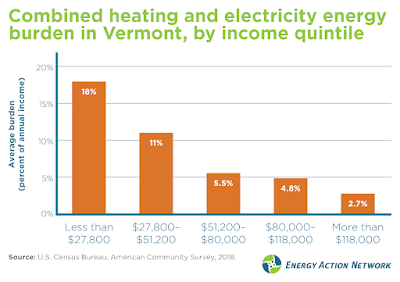
as 40% above last year’s prices. This creates an especially large energy burden
for lower-income Vermonters. Unlike our highly regulated electric sector, which
is subject to the renewable energy standard (RES), fossil fuel corporations are
under no obligation to reduce the carbon pollution of their product. A Clean
Heat Standard (CHS) would require fossil fuel corporations to provide cleaner
heating fuel options and/or pay for pollution-reduction measures that benefit
Vermonters. These include employing cleaner heating options, like heat pumps,
heat pump water heaters, and advanced wood heat to displace fossil fuels, or
supporting weatherization and efficiency measures. A CHS places the obligation
of lowering emissions on fuel sellers while presenting Vermonters with choices
on how and when to move to cleaner heat. To ensure equity in the application of
the CHS we are considering various design options such as requiring a high
fraction of credits to come from serving low- and moderate- income homes,
providing extra credits for providing clean heat in rental housing, and making
incentive payments income-sensitive. Without implementing a CHS, Vermont will
not meet its emissions reduction requirements under the Global Warming
Solutions Act.
As always, I welcome your
emails (myantachka.dfa@gmail.com) or phone calls (802-233-5238).
Apologies!
I apologize for not updating this website since the Legislature adjourned in May of 2021. A lot has happened since then, including a number of articles I wrote for our local newspapers. I have included them below with the following dates:
7/2/2021 General Assembly overrides vetoes
11/29/2021 Rising COVID cases prompt special legislative session
1/8/2022 New legislative session looks ahead
1/22/2022 Artificial Intelligence: Opportunity and Risk
Fortunately, Blogger allows me to backdate the posts to when they should have been posted.
Legislative Report 1/22/2022 - Artificial Intelligence: Opportunity and Risk
Jeopardy host: In the category
Technology, systems (usually software) capable of perceiving an
environment through data acquisition and then processing and interpreting the
derived information to take action or imitate intelligent behavior given a
specified goal.
Watson: What is Artificial Intelligence?
Many years ago, I went through a period of
reading Isaac Asimov’s novels about robots, the kind that exhibited human
functions, what we would call androids today. His first robot novel I, Robot
was a collection of short stories about robots with human-like personalities
that performed various jobs, like childcare for example. Robots and androids have been a staple of literature
from ancient times (search “Robots in Literature”), and most of us are familiar
with those of the Star Wars anthology. We aren’t quite at the C3-PO
stage yet, but the artificial intelligence that the robots of science fiction
exhibited has become a reality with the development of high-powered computers
today.
We are surrounded by artificial
intelligence, also known as “AI”, whether we recognize it or not. The first AI algorithm was created and used
successfully to master the game of checkers in 1956 by Dartmouth scholars. Fast
forward to 2011 and IBM’s supercomputer, dubbed “Watson”, competed against two Jeopardy
champions, and won. The dialog at the top of this column did not actually take
place, but it serves to define what AI is. Today we use AI to guide us to
destinations, predict the weather, translate languages, for facial recognition,
and many other applications. AI is used for scientific research, medical
diagnoses, autonomous vehicles, and more; and the government, including the
Defense Department, funds advanced research in AI. AI is the source of many benefits, but it can
also pose a risk if it is used improperly.
For example, ubiquitous use of facial recognition threatens our
expectations of personal privacy. And systems that determine eligibility for
services can have built in biases.
Already, AI is creating a wave of economic
growth in Vermont with high-paying jobs in this field. The legislature
recognizes both the economic potential and the potential for abuse associated
with AI development and use. Act 137 of
2018 created an Artificial Intelligence Task Force to investigate the field of artificial
intelligence in the State and make recommendations on the responsible growth of
Vermont’s emerging technology markets, the use of artificial intelligence in
State government, and State regulation of the artificial intelligence field.
The task force’s report was issued in January 2020 and can be found at https://legislature.vermont.gov/assets/Legislative-Reports/Artificial-Intelligence-Task-Force-Final-Report-1.15.2020.pdf.
The report states that "there is in
fact a role for local and state action, especially where national and
international action is not occurring. Large scale technological change makes
states rivals for the economic rewards, [whereas] inaction leaves states
behind. States can become leaders in crafting appropriate responses to
technological change that eventually produces policy and action around the
country."
Members of my committee, Energy and
Technology, worked on a bill, H.410, over the summer that implements some of
the recommendations of the Task Force, and we voted it out of committee last
week. It creates an AI Commission under the auspices of the Agency of Digital
Services, and requires a survey of all software applications purchased,
developed, or used by State agencies or departments. We want to know if any
applications use AI, how it is used, and the potential impacts on Vermont
citizens. The bill is awaiting action by the Appropriations Committee and will eventually
be voted on by the full House.
As always, I welcome your emails (myantachka.dfa@gmail.com) or phone calls (802-233-5238).
Legislative Report 1/8/2022 - New legislative session looks ahead
On Tuesday, January 4, the legislature returned to Montpelier in person for the second half of the biennium. In a floor session that lasted about 45 minutes, resolutions were passed to allow the House and Senate to meet and conduct business remotely until January 18 because of the rising number of COVID cases due to the much more contagious omicron variant. The intent of the legislature is to re-evaluate the situation mid-month to determine whether it will be ok to return in-person. As we begin the third year of the COVID-19 pandemic, we have to remain vigilant to prevent its spread as much as possible.
But legislative work must be done. On Wednesday Governor Scott delivered his State of the State address to the Legislature. He laid out his priorities to increase housing, develop Vermont’s workforce, and use the federal assistance that the state received from the American Rescue Plan Act (ARPA) and the Infrastructure Act. His priorities match well with the priorities of the Democratic led Legislature, which is to help families, businesses and our economy thrive. Building on the work we accomplished in 2021, we’re ready to hammer out detailed proposals — and make significant investments — that make a real difference for Vermonters.
This will include taking smart, strategic action on climate. The Vermont Climate Council, created by the Global Warming Solutions Act passed last year, has delivered its report with recommendations on steps to reduce greenhouse gas emissions, sequester carbon through agricultural and forestry land management practices, and adapt our infrastructure to the effects of climate change, and to accomplish these tasks with an eye toward racial and social equity.
We plan to resolve our pension crisis in a way that’s fair to teachers, state employees and taxpayers; create greater equity in the way we fund our schools; increase access to healthcare, mental health and substance abuse treatment; and address many other critical issues as the session moves into high gear.
While unemployment has again fallen to pre-pandemic levels, there are thousands of jobs still waiting to be filled. This workforce problem affects all areas of the economy, including restaurants, retail, nursing, education, broadband, and transportation among others. While we try to grow our workforce from within the state, our future also depends on attracting new workers into Vermont. A lack of affordable housing and available childcare opportunities are major stumbling blocks to young families who would like to become part of the Vermont community. The investments in housing and childcare we made in last year’s budget will get more attention this year.
After two strenuous years of the pandemic, we must continue to do all we can to end it. Vaccines are the primary weapon in our arsenal. Wearing masks in indoor public places helps prevent the spread. Being cautious in our interactions with others protects us and them. We’re all in this together and have to take care of each other. As always, I welcome your emails (myantachka.dfa@gmail.com) or phone calls (802-233-5238).
Legislative Report 11/29/2021 - Rising COVID cases prompt special legislative session
Although it’s been only two years, it seems a lifetime ago that we first heard of the SARS-CO-V2 coronavirus, a.k.a. COVID-19. From March 16, 2020, until July 1, 2021, Vermont, along with most of the country and the world, was in a state of emergency caused by the pandemic. Under Governor Scott’s leadership Vermont fared very well in terms of infections and fatalities. When the vaccines became available a year ago, Vermont was the first state to hit the 80% mark, and we saw positive case rates plummet to near zero leading the governor to lift the state of emergency and allow our lives to return to near normal.
Then, during the summer, the significantly more transmissible Delta variant started to spread throughout the U.S. Despite Vermont’s high vaccination rate, the number of positive COVID cases began rising once again in August and reached a record number of nearly 600 in one day recently. Vermonters are again being impacted in their everyday lives as a result. Parents of children who are exposed are unable to go to work because of having to stay home with their children during the quarantine period. Business owners are impacted by being short staffed. COVID hospitalizations have again risen at the same time hospitals are facing nursing shortages.
As a result, legislators called on Governor Scott to issue an indoor mask mandate to help mitigate the spread. The governor, however, has resisted such a mandate and instead has continued to emphasize vaccination for eligible persons including children 5 years or older. As positive cases grew, he stated that he would be willing to call the legislature back into a special session to pass a limited mask mandate. Speaker of the House Jill Krowinski and President Pro Tem of the Senate Becca Balint met with Governor Scott and agreed to his terms, whereupon he called the legislature back into session.
During this one-day special session, the Senate introduced a bill giving cities, towns and incorporated villages the authority to mandate mask-wearing indoors in public facilities. The House received the bill, debated it on the floor for over two hours, passed it without changes, and sent it to the Governor who signed it the following day. While a statewide mandate to wear masks indoors would have been more uniform, the only option immediately available to the legislature was the governor's proposal. It is notable that the authorization does not apply to school boards, because they already have the authority to implement health measures such as an in-school mask mandate.
If a municipality chooses to implement a mandate, it must be reviewed every 30 days to remain in effect. Furthermore, this authority ends on April 30, 2022. The most effective way of preventing infection or serious illness resulting from an infection is to get vaccinated. For those who refuse or cannot get vaccinated, wearing a mask is a less invasive way of protecting both the wearer and those who encounter the wearer. It is a limited public health measure that we should all be willing to adhere to for the good of our neighbors. Whether or not Charlotte decides to issue a mandate, we all need to pull together and look out for each other to defeat this virus.
Legislative Report 7/2/2021 - General Assembly overrides vetoes
When the Legislature adjourned in May, it allowed for a brief return to consider any legislation Governor Scott might have vetoed. When the governor vetoed his third bill of this session, he tied Governor Howard Dean’s record as the Vermont governor with the most vetoes during his tenure: 21. The veto session also provided an opportunity to finalize action on a bill that got stranded by adjournment. The House convened for the veto session on June 23, and the Senate met on June 24 and 25.
The three bills vetoed during the 2021 legislative session
include:
·
S.107, an act relating to
confidential information concerning the initial arrest and charge of a juvenile
·
H.177, an act relating to the
approval of an amendment to the charter of the city of Montpelier, and
· H.227, an act relating to the approval of an amendment to the charter of the city of Winooski.
S.107 raises the age from 18 to 20 for exempting from public access records related to the arrest and charging of juveniles. The exemption does not pertain to the "Big 12" major crimes. The rationale for raising the age was to conform to the legislation enacted three years ago to treat young adults ages 18 to 20 as juveniles in Family Court rather than as adults for minor crimes. The goal was rehabilitation rather than incarceration. The issue of whether the identity of a young adult should be public arose in part as a result of an automobile accident on Route 7 in Charlotte that resulted in the death of two Ferrisburgh residents when a vehicle driven by a young person crossed into oncoming traffic and hit the couple’s vehicle head-on. The state police released the young person’s name, but was criticized by the Chittenden County States Attorney for doing so. Governor Scott’s veto message disagreed with the provisions in S.107 because he feels the 2018 legislation has not had the predicted positive results and has exposed 18 to 20 year-olds to manipulation by criminal elements because of their more lenient treatment. The Senate declined to attempt an override of this veto during the veto session.
The House, on the other hand, met for one day to take up three items of business. The first item was to send to the Senate S.79, a bill passed on the last day of the session, but which ran out of time to be sent to the Senate before they adjourned. S.79 created a registry for contractors, another registry for rental units throughout the state, and allowed landlords dealing with problem tenants to initiate eviction proceedings despite the emergency moratorium on evictions. This bill was subsequently passed by the Senate when they met and was sent to the governor, who vetoed it this past Friday as veto #22.
The two bills dealing with the charter changes, H.177 and H.227, were considered next. Both of these bills would allow non-citizens who are legal residents of the cities of Montpelier and Winooski to vote in local elections. The charter amendments were passed overwhelmingly at each city’s Town Meeting election. Governor Scott’s objection was that “Allowing a highly variable town-by-town approach to municipal voting creates inconsistency in election policy as well as separate and unequal classes of residents eligible to vote in local elections.” The House voted to override both vetoes by identical 103 to 47 votes. Municipal charters allow towns and cities, with the consent of the legislature, to customize their policies on various issues. The Vermont League of Cities and Towns supported the veto overrides, stating that “until the legislature enables all municipalities to vote to allow non-citizen residents voting rights in local elections, the charter process is the only means municipalities have to achieve this goal.” Following the House action, the Senate concurred in overriding the vetoes by identical 20 to 10 votes on both bills.
Subscribe to:
Posts (Atom)
