New Legislative Maps Approved

 The Vermont House and Senate districts will be changing for the 2022 election.  H.722, the House redistricting bill passed earlier this month, came back from the Senate with their proposal of amendment which added the Senate redistricting proposal. While the Charlotte and Hinesburg House districts are only slightly modified with the Charlotte-Hinesburg district (Chittenden 5) enlarged by one census block of Hinesburg (Chittenden 4), the six-member Chittenden County Senate district was split into three districts: Chittenden North, Chittenden Central, and Chittenden Southeast. Charlotte, along with Bolton, Hinesburg, Jericho, Richmond, Shelburne, South Burlington, St. George, Underhill, Williston, and part of the city of Burlington, will be in Chittenden SE with three senators. Burlington, Winooski and part of Essex will comprise Chittenden Central with three senators, and Milton, Westford, Fairfax and the rest of Essex will make up Chittenden North with one senator. Population shifts over the last decade added one Senate seat to Chittenden county.  The House and Senate redistricting maps can be found at the following sites.

House:

https://legislature.vermont.gov/Documents/SmallMaps/2022/Phase_II/Statewide%203_3.pdf


Senate:

Legislative Report 3/21/2022 - Reaching crossover, Environmental bills score big


As the Legislature hit the crossover date last week, House committees were busy finalizing work on the dozens of bills they had been working on since January. The once-a-decade legislative reapportionment bill was finalized and passed, and the Charlotte-Hinesburg district, Chittenden 5, again contains all of Charlotte and a slightly larger portion of Hinesburg, running along the west side of Baldwin Road from the Monkton line to Burritt Road. (Map)


Among the many bills that passed and were sent on to the Senate, were several that touched on the environment and our efforts to address the climate change crisis. The Municipal Efficiency Resilience Initiative (H.518) passed unanimously to help municipalities assess the energy efficiency of their buildings and apply for grants to weatherize, reduce operation and maintenance costs, enhance comfort, and reduce energy use by improving heating, cooling, and ventilation systems. The Clean Heat Standard bill (H.715) also passed with a strong 96 to 44 vote to help homeowners, renters and commercial properties reduce their dependence on fossil fuels for heating.


The Natural Resources, Fish and Wildlife Committee sponsored several important bills including H.500, which prohibits the sale, starting in 2024, of four-foot linear fluorescent lamps in Vermont for which LEDs are available. All fluorescent lamps contain mercury and can create an immediate public health and environmental hazard when they accidentally break during installation, use, transportation, storage, recycling, or disposal. Light-emitting diode (LED) replacements for fluorescent lamps do not contain any mercury. Another bill, H.523, seeks to reduce hydrofluorocarbon emissions. Hydrofluorocarbons are potent greenhouse gases and enter the atmosphere as leakage from cooling systems. Products that contain hydrofluorocarbons for use in refrigeration systems and auto air conditioners are prohibited starting in 2024. Alternative refrigerant products are available.


Forests play an important role in Vermont’s working landscape, and in its tourist and recreation economy. Currently only actively managed forests are
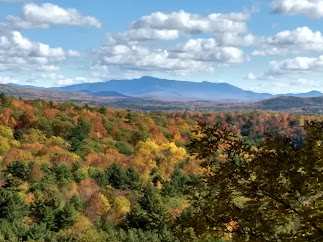
A view of Camels Hump from Niquette State
Park.   Photo by Mike Yantachka

 eligible for enrollment in the Use Value Appraisal (Current Use) program. Forests that exhibit old forest characteristics can provide unique contributions to biodiversity, contribute to the climate resilience and adaptive capacity of Vermont’s working landscape, and serve as ecological benchmarks against which to measure active management of Vermont’s forests. The House passed H.697 which creates a pilot program to extend eligibility for current use for forest parcels that are left wild and meet certain criteria with the approval of the Commissioner of Forests, Parks and Recreation.


This forest program will complement nicely another bill, H.606, the Community Resilience and Biodiversity Protection Act. Nature is facing a catastrophic loss of biodiversity, both globally and locally. In addition to its intrinsic value, biodiversity is essential to human survival. According to the United Nations one million species of plants and animals are threatened with extinction, and human activity has altered almost 75 percent of the Earth’s surface, squeezing wildlife and nature into ever-smaller natural areas of the planet. The health of ecosystems on which humans and all other species depend is deteriorating more rapidly than ever, affecting the very foundations of economies, livelihoods, food security, health, and quality of life worldwide. The causes of the drivers of changes in nature rank as: (1) changes in land and sea use, (2) direct exploitation of organisms, (3) climate change, (4) pollution, and (5) invasive species. According to the Nature Conservancy Vermont plays a key role in the conservation of biodiversity regionally.  H.606 sets a goal of conserving thirty percent of Vermont’s total land area by 2030 and 50 percent by 2050, including state, federal, municipal, and private land. It requires the Agency of Natural Resources to develop a plan by the end of 2023 with public input from all stakeholders. These bills and many others now move to the Senate.


As always, I welcome your emails (myantachka.dfa@gmail.com) or phone calls (802-233-5238).  

Legislative Report 3/7/2022 - The war in Ukraine and our heating costs


Surely, we are all horrified by the devastation that is happening in Ukraine.  The uncalled-for war initiated by Vladimir Putin has outraged the world and resulted in a unified front against Russia in support of the Ukrainian people.  The strong economic sanctions are totally justified and must remain as long as Russian forces continue their assault and occupation.  We will have to stand firm regardless of the economic pain that the sanctions cause in the U.S. and among our allies in Europe and around the world, because that pain is nothing compared to the pain being visited on the people of Ukraine.


Om March 8 the Vermont House voted to send $643,077, which represents $1 for every Vermonter, plus $1,749 from sales of Russian-sourced liquor sold in Vermont  between February 24 and March 2 for humanitarian relief in Ukraine. In addition, many House members bought sunflowers, the Ukraine national flower, and displayed them at our desks.


One of the biggest effects in the U.S. is soaring oil prices which is driving already high inflation even higher. With gasoline topping $4 per gallon and heating oil not far behind, the remainder of the heating season as well as our daily commutes will be more costly than previously expected. The questions many are asking are “What can we do about it? How can I handle the added expense?”  These questions are at the forefront of policymakers in Montpelier as well. One thing we can do is help Vermonters reduce their dependence on fossil fuels.


The Governor has proposed, and the House Committee on Energy & Technology has recommended, that $80M be allocated for weatherizing 8,000 low-income and moderate-income residences between 2022 and 2026. Vermont homeowners and tenants with low incomes will be eligible for no-cost, comprehensive home weatherization services through Vermont’s Home Weatherization Assistance Program administered by the Office of Economic Opportunity and delivered through six Weatherization Assistance Providers. Weatherization of buildings with five or more units will be delivered through 3E Thermal, a team of consultants who help apartment building owners increase energy efficiency and improve building performance. Vermonters with a moderate income will be eligible to receive incentives through Efficiency Vermont and its network of contractors to support the cost of home weatherization. Weatherization will reduce the amount of fossil fuels needed for heating and thereby reduce the cost of heating.


In addition, $20 million in ARPA funds is recommended for low and moderate-income Vermonters to upgrade home electrical systems and install energy saving technologies such as cold-climate heat pumps in conjunction with weatherization. Another $5M is recommended to help approximately 3,000 low-income Vermonters that have a fossil fuel water heater at least 10 years old to replace it at low or no cost with a heat pump water heater to reduce their energy costs and emissions. These alternative heating appliances will further reduce dependence on fossil fuels and their associated cost.


While the situation in Ukraine was not a consideration when the Vermont Climate Council proposed a Clean Heat Standard, it may turn out to be an effective tool when combined with the state’s share of ARPA funds in counteracting the heating costs of Vermonters. By allowing clean heat measures like weatherization, heat pumps, and heat pump hot water heaters installed starting January 1, 2022, to create Clean Heat Credits, we can get a jump start on reducing emissions as well as costs of residential heating.  These credits will be readily available for purchase by fossil fuel dealers to meet their clean heat credit obligations which are expected to start in 2024. Or they can generate credits themselves by helping their customers transition to these clean heat measures.


We don’t know how long the war in Ukraine will continue, how the sanctions will affect Putin’s conduct, and what the outcome will be.  But fuel prices that were already high before the war will probably continue to be so. For every gallon of heating oil or gasoline we can avoid using, we will further insulate ourselves from the volatility of fossil fuel prices as well as reduce our greenhouse gas emissions.


As always, I welcome your emails (myantachka.dfa@gmail.com) or phone calls (802-233-5238).  

Legislative Report 2/21/2022 - 2022 Town Meeting Legislative Report


Town Meeting marks the halfway point in the Vermont legislative session, and it’s a good time to highlight some of the work the legislature has accomplished.  The House passed some significant legislation in these first two months, and we will continue to work on our key priorities in collaboration with the Senate prior to our anticipated May adjournment.


One of our priorities is to use Vermont’s share of federal stimulus funds to boost recovery and set the stage for a strong future, while building a balanced budget that reflects our values as we tackle the complex and interconnected challenges of housing, workforce, and childcare. Of the $1.049 billion Vermont received from the American Rescue Plan Act (ARPA), over $600 million was allocated for

fiscal year 2022 (FY22) investments, leaving more than $400 million available. This infusion of federal dollars will not be sustained over time, nor will state revenue levels which have been outpacing forecasts. In developing the FY23 budget, our challenge is to make strategic use of one-time money to address extraordinary ongoing needs in order to support and strengthen Vermont communities, families, and vulnerable Vermonters now and into the future.


Workforce development is another one of our legislative priorities this year. With 25,000 job openings in Vermont and an unemployment rate of just 2.5 percent, we’re trying to identify and remove the barriers that are preventing people from working or returning to work. We’re also listening to education and training providers to see if we can provide better opportunities for Vermonters to gain postsecondary credentials and degrees of value, which increase earning potential in rewarding careers. Vermont’s 17 regional Career and Technical Education (CTE) centers provide critical pathways to improve career readiness for students and adult learners and play a big role in workforce development. Stakeholders across Vermont in the business, nonprofit, education and government sectors have committed to a common goal of having 70 percent of Vermonters possess a postsecondary degree or credential of value, such as an apprenticeship, certificate or license. The legislature is considering several proposals to revamp and support CTE, with bills under consideration in several committees. While there are worker shortages across the board, the shortage of nurses has put severe pressure on our healthcare system due to COVID-19. This is exacerbated by a shortage of nursing professors. The legislature is looking for ways through scholarships and grants to support Vermont’s colleges in expanding their nursing programs, attracting nursing professors and helping current RNs who wish to become professors.


The Legislature recognizes that climate change is an existential threat to our way of life and several bills aim at reducing our greenhouse gas emissions in the two categories producing the most emissions: transportation and heating. I have previously written about two bills from my committee, Energy and Technology, that promote municipal energy resilience and help Vermonters reduce their dependence on fossil fuels for heating. The House Transportation Committee is reviewing the Governor’s “Transportation Bill,” which recommends approximately $40 million in investments to support a state highway electric vehicle (EV) charging network and incentives for EVs as well as electric bicycles, ATVs, and snowmobiles. The Transportation Innovation Act (H.552) has similar objectives and also includes funding for transportation programs for lower income Vermonters and continuation of zero-fare public transit. These initiatives will be helped by the bipartisan Infrastructure Investments and Jobs Act (IIJA), signed into law by President Biden in November 2021.


There is a lot of work being done in many other areas including pension funding, support of the forest economy, registration of construction contractors, support for mixed-income and multi-family housing, racial and social justice, telehealth initiatives, toxic waste, and more. Bills dealing with these issues will be coming up for a vote in the two weeks after Town Meeting to meet the crossover deadline when bills need to be passed in order to be considered by the Senate.  Stay tuned.


Legislative Report 2/7/2022 - We can clean up our heating sources


It is very apparent by now that climate change is happening both locally and globally with rising average temperatures and devastating effects, including extraordinary wildfires, flooding, and other extreme weather events. In September 2020, the Vermont Legislature enacted the Global Warming Solutions Act (Act 153) that set greenhouse gas (GHG) reduction targets and created a Climate Council to develop a Climate Action Plan (CAP) to achieve those targets. The Climate Council published its report in December 2021, and in January the Legislature began working to implement it.


Transportation accounts for about 40% of GHG emissions in Vermont and heating accounts for about 34%.  Targeting these two energy-intensive sectors will give us the best chance of meeting the target of a 40% reduction from 1990 levels of GHG emissions by 2030. The House Energy and Technology Committee has started crafting legislation from some of the specific recommendations of the Climate Action Plan regarding heating, including a Municipal Energy Resilience Plan (bill H.518) and a Clean Heat Standard.


The Climate Council was careful to insist that whatever
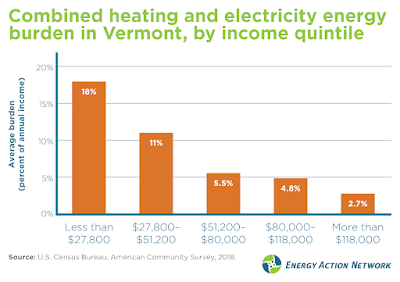
measures were taken to reduce GHG emissions, that they be done in an equitable manner to prevent impacting those with the highest energy burden.  Energy burden is defined as the total household energy expenses for heating and electricity divided by household income. The highest energy burden is experienced by the 20% of Vermonters with the lowest income as shown in the accompanying chart. Energy burden profiles can also be associated geographically with the highest energy burdens occurring in rural communities because of increased transportation fuel costs.


Vermont’s cities, towns and villages own and maintain approximately 7,000 old buildings that are expensive to heat and have a large carbon footprint. To meet our climate goals and ease the energy burden on municipal budgets, H.518 will support communities with technical assistance, design support, and funding to make municipal assets more energy efficient and to displace fossil fuels with cleaner options. It will expand the State Energy Management Program to help municipalities finance improvements and assist municipal leaders, who may lack the technical expertise to assess the best investments to increase efficiency and resilience, with help from Efficiency VT and regional planning commissions.


With one-third of Vermont’s climate pollution coming primarily from fossil fuels used to heat our buildings and water, dependence on fossil fuels is expensive with unpredictable price swings for consumers. If you heat your home with oil or propane, you’re paying as much as 40% above last year’s prices. This creates an especially large energy burden for lower-income Vermonters. Unlike our highly regulated electric sector, which is subject to the renewable energy standard (RES), fossil fuel corporations are under no obligation to reduce the carbon pollution of their product. A Clean Heat Standard (CHS) would require fossil fuel corporations to provide cleaner heating fuel options and/or pay for pollution-reduction measures that benefit Vermonters. These include employing cleaner heating options, like heat pumps, heat pump water heaters, and advanced wood heat to displace fossil fuels, or supporting weatherization and efficiency measures. A CHS places the obligation of lowering emissions on fuel sellers while presenting Vermonters with choices on how and when to move to cleaner heat. To ensure equity in the application of the CHS we are considering various design options such as requiring a high fraction of credits to come from serving low- and moderate- income homes, providing extra credits for providing clean heat in rental housing, and making incentive payments income-sensitive. Without implementing a CHS, Vermont will not meet its emissions reduction requirements under the Global Warming Solutions Act.


As always, I welcome your emails (myantachka.dfa@gmail.com) or phone calls (802-233-5238).  

Apologies!

 I apologize for not updating this website since the Legislature adjourned in May of 2021.  A lot has happened since then, including a number of articles I wrote for our local newspapers. I have included them below with the following dates:

7/2/2021  General Assembly overrides vetoes

11/29/2021  Rising COVID cases prompt special legislative session

1/8/2022  New legislative session looks ahead

1/22/2022  Artificial Intelligence: Opportunity and Risk

Fortunately, Blogger allows me to backdate the posts to when they should have been posted.